

Recent Posts
Share Post
DevOps for Beginners: Essential Skills, Tools, and Career Roadmap for 2026
Software development has changed significantly as organizations look for faster, more reliable ways to build, test, and deploy applications. Traditional development and operations workflows can create delays when teams work independently or rely on repetitive manual processes.
DevOps addresses these challenges by encouraging collaboration, automation, continuous integration, continuous delivery, and ongoing monitoring. For students, fresh graduates, system administrators, and IT professionals, learning DevOps can be a valuable step toward working with modern software infrastructure. In this guide, we will explain what DevOps is, which tools you should learn, and how to build a practical learning roadmap.1. What Is DevOps?
DevOps is a combination of practices, processes, and tools that helps development and IT operations teams work together throughout the software delivery lifecycle. Its main objectives include:- Automating repetitive tasks.
- Improving software delivery speed.
- Reducing deployment errors.
- Increasing system reliability.
- Encouraging collaboration between teams.
- Improving monitoring and feedback.
2. Learn Linux Fundamentals
Linux is widely used in cloud infrastructure, application servers, containers, and deployment environments. Before moving to advanced DevOps tools, become comfortable with essential Linux commands. Start with:- File and directory management.
- User and permission management.
- Process monitoring.
- Package installation.
- Network troubleshooting.
- Shell scripting.
- Log inspection.
3. Understand Git and Version Control
Git allows developers and operations teams to track code changes, collaborate on projects, and maintain a history of their work. Important concepts include:- Repositories and commits.
- Branches and merging.
- Pull requests.
- Conflict resolution.
- Remote repositories.
- Release tags.
4. Learn Docker and Containerization
Docker helps package applications and their dependencies into containers, making them easier to run consistently across different environments. Key concepts to understand include:- Images and containers.
- Dockerfiles.
- Container networking.
- Persistent storage.
- Docker Compose.
- Container registries.
5. Understand CI/CD Pipelines with Jenkins
Continuous Integration and Continuous Delivery or Deployment (CI/CD) help automate the process of building, testing, and delivering software. Jenkins is a widely used automation server that can coordinate these workflows. A basic CI/CD pipeline may include:- A developer pushes code to a Git repository.
- The pipeline retrieves the updated code.
- Automated tests run.
- The application is built and packaged.
- The deployment process releases the application to a target environment.
- Monitoring and validation help confirm that the release works correctly.
6. Explore Terraform and Infrastructure as Code
Infrastructure as Code (IaC) allows teams to define and manage infrastructure using configuration files instead of relying entirely on manual setup. Terraform is a popular tool for this purpose. Learn the following concepts:- Providers and resources.
- Variables and outputs.
- Configuration files.
- State management.
- Reusable modules.
- Infrastructure planning and deployment.
7. Build Cloud Computing Skills
DevOps engineers frequently work with cloud platforms to provision infrastructure, deploy applications, and automate operations. Consider learning AWS first if you want to focus on a broad range of infrastructure and DevOps services. Useful AWS topics include:- EC2 for virtual servers.
- S3 for object storage.
- IAM for identity and access management.
- VPC for networking.
- CloudWatch for monitoring.
- AWS services for deployment and automation.
8. Follow a Practical DevOps Learning Roadmap
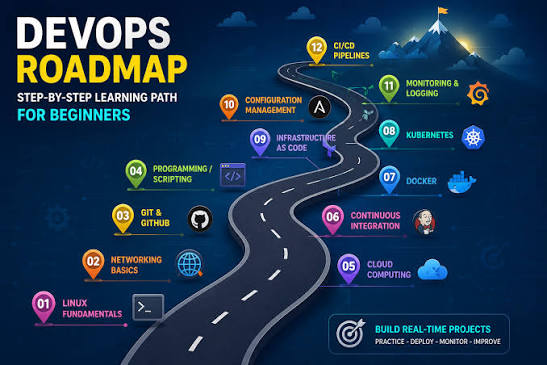
Here is a suggested learning sequence for beginners. The timeline is illustrative and depends on your previous experience and weekly study time. Phase 1: IT Fundamentals Learn Linux, networking, operating system basics, and command-line usage. Phase 2: Version Control and Scripting Practice Git, GitHub workflows, and basic Bash or Python scripting. Phase 3: Containers and CI/CD Learn Docker, Docker Compose, Jenkins, automated testing, and pipeline fundamentals. Phase 4: Cloud and Infrastructure Automation Study AWS fundamentals, Terraform, networking, security, and cloud resource management. Phase 5: Projects and Advanced Tools Build end-to-end deployment projects, then explore Kubernetes, monitoring, logging, and infrastructure security. At every stage, build something practical instead of relying only on video lessons or theoretical study.9. Build Projects for Your Portfolio
Practical projects help you apply your knowledge and explain your skills during interviews. Consider these beginner-friendly projects: Project 1: Automated Application Deployment Use Git and Jenkins to automate the build and testing of a sample application. Project 2: Containerized Web Application Package an application with Docker and configure its services using Docker Compose. Project 3: Cloud Infrastructure Automation Use Terraform to provision a small cloud environment with appropriate network and access controls. Project 4: End-to-End CI/CD Pipeline Combine source control, automated testing, containerization, and deployment into one workflow. For every project, document the architecture, tools, setup steps, challenges, and solutions in a README file.10. Can Beginners Build a Career in DevOps?
Yes, beginners can work toward DevOps-related roles, but the field requires consistent practice and a solid technical foundation. Potential career paths include:- Junior DevOps Engineer.
- Cloud Support Associate.
- Cloud Operations Engineer.
- Site Reliability Engineering (SRE) trainee.
- Build and Release Engineer.